
Paint Booth Smorgasbord
Autosphere » Collision »
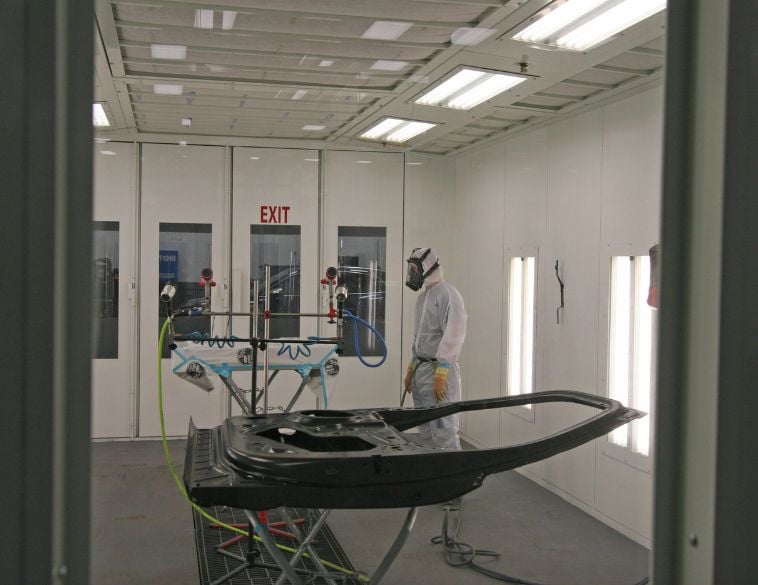
Ventilation, filtration and employee safety are prime considerations when shopping for paint booths today. (Credit : Huw Evans)
The range of options continues to expand.
Today’s paint booths offer a very substantial range of options and technologies, but given the potential costs faced by collision repair shop operators, setting priorities and selecting the right fit-purpose suite of tools and equipment is important. A lot has changed since the 1980s. “Technology then was nowhere near what it is today. Back then, an extra bumper or other part that needed painting would be painted in a paint booth, which were much cheaper then,” says Nick Brown, Technical Trainer in Ontario for Fix Network.
Ventilation system
A new booth today can cost $250k to $350k, including a whole range of technology. For example, in the past, paint booths often came without blowers. Now, all modern paint booths utilize a ventilation system, which typically includes blowers. These are fans that ensure proper airflow, to ensure a safe and efficient painting environment, remove fumes and over-spray, and manage air pressure, and are generally regarded as both an essential safety and performance feature for paint booths.
With the current mix of personal transportation options in use—gasoline- and diesel-powered cars and trucks, LNG, hybrid and all-electric vehicles—paint booth equipment with good temperature control systems is becoming essential, Brown says. Gasoline vehicles can usually be baked for drying in a temperature range of 120 to 140 degrees Fahrenheit. “But for hybrids or full EVs, you mostly have to bake at a lower temperature. Tesla and some hybrid OEMs recommend a lower temperature, so shops do them at the end of the day. Some specs I’ve seen indicate the temperature be no hotter than 110 degrees Fahrenheit,” Brown says.
Finely tuned
A widening variety of finely tuned blower-based airflow systems are available, and costs vary depending on features. In a booth with a fully grated floor, air comes down from the top in a vertical downdraft and is sucked out through the floor. Another system in which the air descends at an angle has a lower cost, but fewer filters. Either way, an air-flow system must prevent “fogging” that can compromise paint distribution on the vehicle being painted. It must also ensure that specks of dust, etc. don’t get a chance to land on a newly painted surface. Buyers need to decide what system will get their shop the required performance bang for their buck.
Whatever options the shop operator selects, there remains the key objective: “The main goal is to restore the vehicle to pre-accident condition. A good painter is going to ensure that the paint job matches the existing finish—so you can’t see it has been fixed,” Brown says.
It’s perhaps no surprise that the precise location of the paint booth itself has a role in supporting a smooth, efficient workflow in the shop, and avoiding bottlenecks. Experts seem agreed that a prep bay should be close by, preferably adjacent, to the paint booth, so that a prepped car moves as little as possible.
Split booths
Besides automated blowers that are much quieter than in the past, Brown says that split booths are now available, with one side dedicated to a bake cycle and the other to infrared drying. This combines the benefits of both methods for efficient and high-quality paint finishing. The bake cycle side provides a controlled environment for curing paint, while the infrared side offers rapid drying and reduced cycle times.
Like so much with paint booth options, the variety for airflow blower systems doesn’t stop at straight down or at-an-angle. Cross-draft systems are also available.
Although an all-electric paint booth system was recently developed by Blowtherm, because of a client request, most paint booth systems tend to use a lot of natural gas to heat the air which must be distributed as per specifications. “Energy efficiency is an issue. Any heat recovery system which can reduce the amount of gas needed is of interest, says Domenic Prochilo, COO at Simplicity Car Care.
UV infrared
Saving energy, cutting costs without compromising quality, and improving throughput are priorities at Simplicity, as elsewhere across the industry. The company, working with franchisees, is exploring possibilities in UV infrared and water-borne primer. A method of applying paintless dent repair principles to fix large dents is also being looked at, Prochilo says.
Modifications and improvements at collision repair shops can be a challenge in cities like Vancouver and Toronto where land is at a premium. Land for even a small expansion might be unavailable. Or even getting a permit for an $500k expansion could be difficult, especially if the shop is in a big city location where City Hall sees high rise development potential, says James Carruthers, Technical Sales Specialist at Pacific Spray Booths Ltd., a body shop equipment supplier in Surrey, B.C.
In these circumstances having the mechanicals above the ceiling or integrated with the roof is an advantage, as they are not taking up valuable floor space. Carruthers suggests that installing a full downdraft spray booth and doing the associated concrete work can be very expensive with recent cost increases, even out of the question if the shop operator doesn’t own the land or have a long-term lease.
Workflow characteristics
Projected workflow characteristics should help shape shop layout and design. If there is a good mix of both small and large work orders, a separate “express” lane for lighter jobs is a good option. It can help smooth out workflow, Carruthers says.
Heat recovery systems are attracting a lot more interest, he says. They can be used to heat the shop. Although big heat exchangers make for high up-front costs, in regions of Canada like the Prairies and northern Ontario, anywhere the winters are cold, “The system can pay for itself in three to five years.”
Automation is also helping with energy savings. For instance, if a spray gun goes without being used for 15 minutes, booth systems stop running at “paint speed” – in effect going into “sleep” mode.
A trend in the quest for additional market opportunities is reflected in a growing number of shops opting for bigger paint booths. One reason for this is that smaller transit companies and trucking outfits often don’t have their own paint booth for repairs, so they look for shops with the capacity to service small-to-mid-size trucks and buses, etc.
The Great Retirement, indirectly, is another spray booth design input that’s currently pushing change. As older paint techs leave the work force, Carruthers says, the new, young recruits are savvier than their predecessors about hazards like VOCs and other health and safety issues. “Booth operators are taking notice. They are investing money on the accessory side to address health and safety. There is not a lot of change in equipment, but operators are investing in better filtration systems and improving maintenance regimes.”
An appropriately timed maintenance schedule can identify everything from weak spots in filtration to problematic components that could fail and cause down-time. That can mean a healthier workplace minus unforeseen and unwelcome shutdowns. What’s not to like?

JOBS
 |  GRANBY GRANBY Full time Full time |
 | ILE DES SOEURS Full time |
 | BROSSARD Full time |
| LAVAL Full time |
| LAVAL Full time |