
Beating the Bottleneck Bugbear
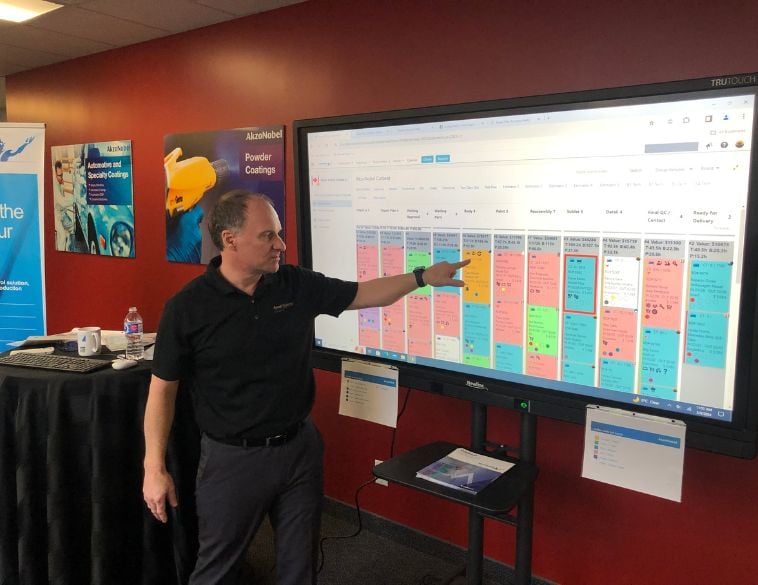
Tools like AkzoNobel's CarBeat can have a huge impact on production and shop efficiencys. (Credit : Huw Evans)
The collision repair sector is rolling out strategies and AI to boost workflow efficiency.
Whether they are selling shop lay-out systems and the latest drying technology, supplying paints and refinishing products, or operating a nation-wide network of body shops under a franchise banner, experts agree that the most important key to both operational success and profitability is an efficient shop workflow that reduces bottlenecks to a bare minimum.
“In North America, most of our competitors are paint booth suppliers or they’re doing prep stations, or paint mixers. We are selling efficient shop workflow and equipment that aims at that,” says Les Pawlowski, General Manager for Symach Body Shop Solutions in Canada and the U.S.
Complete shop systems
With its headquarters and a manufacturing plant in Bologna, Italy, Symach offers a range of products and technologies as well as complete shop systems like Fixline Dryking, which is configured to do seven to eight jobs a day. Symach’s product line includes drying robots, a vehicle-moving system—which eliminates the need to drive the vehicle from one end of the shop to another—and paint booths, among others.
Pawlowski says that better products and new technologies can help—but only if the workflow across the shop is smooth and efficient. “Otherwise, a new product only seems like added efficiency,” he says. “Your ROI on a replacement spray booth is going to be zero, despite faster baking etc., if the shop workflow is stymied with bottlenecks somewhere along the process.”
Pace and product
The extra cost of a UV primer, for example, which costs more than a 2-k primer, but dries in a few minutes instead of about two hours like 2-k, can be money down the drain, if other phases of the shop operation don’t keep up. “The workflow pace must match the product being used,” Pawlowski says.
Technological advances can have an important role, and he points to a catalytic infrared (IR) paint drying product, Infrared Drytonic, which the company offers. Catalytic IR drying has several benefits, including faster drying times, lower energy costs, and allows for precision-targeted heating that ensures consistent curing across the coating. The company’s robotized system, in which the infrared wave can be adjusted, moves over a surface at a specified rate, enabling a fast-drying process. Pawlowski notes, “It can be applied to any kind of paint.”
This occurred shortly after Symach was launched in 2001, but, no surprise, cutting 50 minutes off a one-hour process relieved one bottleneck only to create another. This sparked the development of a broader product portfolio and applying a logistics approach to the design of the entire shop space that encompasses the repair process from start to finish. The Fixline Dryking, which includes Symach’s vehicle-moving system, is designed to account for the time for each task in each phase of operations, so that the overall shop lay-out reduces the chance of bottlenecks and ensures that staff are occupied in each bay all the time. “The collision repair process should be on a factory manufacturing basis,” Pawlowski says.
Communication is key
Communications, especially system-based ones, can have a huge impact on monitoring and tracking the process of each repair, and seeing where improvements can be made. “A real-time production management tool has the most significant potential to transform how repairs are monitored and tracked,” says Aaron Hebb, Services Consultant, Eastern Canada, for automotive & specialty coatings, at AkzoNobel Coatings.
It is best to keep it as simple as possible when introducing such a system, he says, as, after all, many of the staff that use it are typically busy with touch-based work that must not be allowed to suffer. A shop without a software application like Carbeat from AkzoNobel Coatings could start the process of better tracking with something as simple as a whiteboard, Hebb says.
The key is simplicity, assisting staff with updating every order in real-time at each stage of the repair process. “When maintained consistently, this kind of management software tool provides a birds-eye view of all active repair orders, enabling strong communication among internal teams and ensuring reliable updates for external stakeholders as well. The real power of such a system lies in its ability to support real-time decision-making based on real-time data. This visibility enables shops to identify bottlenecks in advance, reduce cycle time, and increase throughput, ultimately improving both profitability and customer satisfaction. Products like Carbeat are designed to do just that,” Hebb says.
With this kind of software at everyone’s fingertips, the front-office person who picks up the phone can at once answer a customer’s query and check exactly where the vehicle is in the repair process. No need to run to the back and bother someone who is busy—perhaps on another customer’s vehicle at that moment.
Extensive role
Communications don’t stop there, however. They have an important and extensive role in the collision repair environment, and should have structure, accountability and transparency, Hebb says. “A clear communications plan must be in place, including consistent routines and well-defined expectations. This can involve daily production meetings and front office huddles, where the purpose, frequency and format are clearly outlined and consistently followed. These routines create rhythm and predictability, enabling teams to anticipate and resolve issues before they escalate.”
Internally, he says, the communications plan can also define roles and responsibilities, both at the departmental and individual levels. Everyone will then know who communicates what, when, and to whom.
Shops, along with outside stakeholders, can benefit from a structured communications approach, Hebb says. This can help all the parties—vendors, suppliers, insurance companies, customers, and the shop —stay on the same page.
He says AI could have an increasing role in augmenting external communications, for example, answering phone calls after hours from customers and other stakeholders and providing updates on a specific vehicle, etc. Robotic phone systems are improving and can be expected to soon be significantly better than what many have experienced with utility company phone bots.
In today’s environment, with vehicle complexity continuing to increase rapidly, it’s no longer sufficient to perform basic visual or photo-based estimates and then initiate repairs, according to Hebb and others interviewed for this article. A more detailed and precise estimating process is increasingly being deployed and this in turn enables the formulation of a comprehensive repair plan. A plan is viewed as essential for achieving the desired results efficiently and involves allocating appropriate uninterrupted time for each phase in the process, ensuring the right tools and data are in place when needed, including up-to-date information on OEM procedures, positioning statements, parts diagrams and technology.
Technological advancements
Beginning with estimating, the entire repair process appears to be evolving fairly quickly on both technological and operational fronts. “Technological advancements are reshaping the repair process, particularly with the growing use of artificial intelligence throughout the process,” says Hebb. “AI is beginning to aid in tasks like image-based estimating, and workflow optimization.” He notes that AI-assisted estimating tools can act as a second set of eyes for estimators, enabling them to be as accurate as possible at the beginning while saving them valuable time. “As these tools become more integrated into management systems, we can expect AI to provide real-time, shop specific recommendations. Tools like predictive scheduling for maximum efficiency and profitability, along with live production management recommendations to further refine operational performance. AI is already having an impact,” Hebb says.
Operationally, he adds, the industry is shifting to greater standardization and lean principles “to reduce variability, minimize waste and accelerate cycle times.”
Quantifying some of the efficiency measures advocated by Hebb and others in the collision repair industry highlights their potential impact on economic performance. Domenic Prochilo, COO at Simplicity Car Care, says that at some shops, “95% of the activities that go on are non-value-added processes, i.e. waste. If you can reduce that 95% to 50%, that’s huge, and means four hours touch time per eight-hour shift, instead of an hour or an hour and a half. For every additional 0.3 hours touch time equals an added one per cent to a shop’s gross margin. Going from 1.5 to 4.0 hours touch time can result in about a 9% gross margin increase. It can be quite hard to do.”
Inevitability
Shops in the 95% inefficiency range have been common in the industry, he says. Simplicity Car Care, which has about 100 franchisee outlets, has a business management plan for them, says Prochilo, who notes that some bottlenecks are inevitable in many, if not all businesses.
Among other things, the plan emphasizes detailed estimating and planning with effective communications between estimators, body tech, paint tech and parts staff. Also, on a day-to-day basis, shops should schedule in relation to shop capacity, not demand. If a shop has the desirable problem of demand stretching capacity, consider expanding the team or adding a shift, Prochilo advises.
Comprehensive diagnosis, estimating and planning followed by good execution can help keep supplemental work – which both customer and shop want to avoid – to 5% or less of most work orders.
The technological complexity of modern vehicles highlights the importance of planning and estimating that takes into account features that were scarce until recently. For instance, sensors that trigger responses of automated driving assistance systems (ADAS) must be properly accounted for throughout the repair process. Failure to do so could result in supplemental work – even involve the driver in a crash.
Prochilo cites what’s called the 20/80 rule. Known as the Pareto principle, and named after an Italian economist, Vilfredo Pareto, it states that roughly 80% of effects stem from 20% of causes. In a business environment, it highlights the fact that relatively few inputs —causes—produce the majority of outputs, and so encourages identifying those critical inputs that make a difference. It seems like a good principle for most businesses—including those in the collision repair sector.
Categories : Unclassified


JOBS
 |  VAL-DAVID VAL-DAVID Full time Full time |
 | SAINTE-AGATHE-DES-MONTS Permanent |
 | LAVAL Permanent |
 | BROSSARD Full time |
 | ST-HUBERT Full time |