
Injury Prevention: Introducing Exoskeletons
Autosphere » Tires »
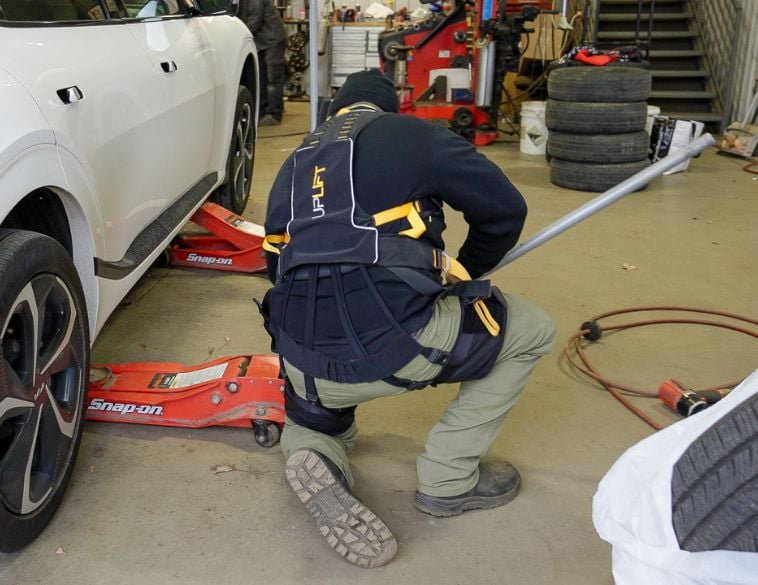
Mawashi’s UPLIFT exoskeleton supports every movement of the technician and reduces the load on their back. (Credit: Mawashi)
A technician leans under a hood, arms extended, shoulders under tension—a common scene that can be observed in any repair shop. What is less common, however, is seeing that same technician finish the day pain-free, with plenty of energy left for activities. Yet that is exactly what is promised by Mawashi, a discreet Quebec company whose expertise is now attracting special forces as well as dealerships and tire centres.
Simon Pesant, Customer Experience Director at Mawashi for eleven years, is the go-to person for field deployment. He knows these exoskeletons inside out. “Our specialty is developing systems that fit the human body while maintaining proper biomechanics, ergonomics, and ease of movement. That’s what sets us apart.”
Founded in 2003 in Saint-Jean-sur-Richelieu, the company initially designed protective equipment for martial arts (body protectors), before rapidly expanding its lineup into law enforcement for crowd control and hand-to-hand combat training.
In 2014, a U.S. government initiative challenged companies to increase special forces’ ballistic protection while maintaining mobility. Five years later, Mawashi emerged as the only bidder to complete all three phases. The first and only declassified phase granted them the intellectual property for the UPRISE. Today, this fifth-generation passive titanium structure redirects up to 70% of a load to the ground, serving a highly exclusive military market.
Military expertise serving civilians
Mawashi leveraged this expertise to launch the civilian UPLIFT in 2019. Less flashy but equally ingenious, it uses elastics to match wearer movements and reduce muscular effort by 20% to 50%. “We don’t want to replace humans, but rather help them accomplish their tasks,” says Pesant. Operating without external power, the system offers unlimited autonomy.
The lineup comes in two versions. The UPLIFT Modular integrates back support, removable shoulder supports, and knee assistance. The UPLIFT Lite, born directly from customer feedback, focuses on compactness. Designed solely for the back, it hugs the body with a minimal footprint. “Statistics show that over 54% of workplace injuries are back-related. This is a major issue for many companies,” he highlights.
The UPLIFT Lite offers ideal postural support for automotive shops. For tire changes, under-hood mechanics, or fabrication, it assists during leaning and repetitive tasks without limiting mobility. The wearer can easily glide from one workstation to another without restriction. The system’s versatility sets it apart from traditional fixed lifting equipment, which many workers intentionally bypass during peak periods due to a lack of time.
As for the return on investment, the math is quick. An exoskeleton retails between $1,400 and $5,000, while a bill for a musculoskeletal back injury can easily reach tens of thousands of dollars for an employer. As a bonus, “workers accumulate less fatigue, and their efficiency remains high throughout the day. We don’t necessarily increase the pace, but we allow them to maintain it consistently,” Pesant says. Some users even report returning home with enough energy to play sports, something unthinkable before.
Small size, major impact
At 1.5 kg and aligned with the centre of gravity, the UPLIFT Lite goes almost unnoticed. Two torso sizes with seven adjustment levels each, combined with three thigh harness sizes, allow it to fit approximately 95% of the population. This achievement was made possible by a multidisciplinary team of mechanical engineers, industrial designers, and human factors specialists (kinesiologists, ergonomists, and biomechanists) whose work relies on a database of “4,000 to 6,000 anthropometric scans field-tested.”
Mawashi already counts clients in the automotive sector, including a dealership in Saint-Jean-sur-Richelieu, a tire centre on Montreal’s South Shore, and the bus manufacturer Prévost. The firm is also collaborating with the Institut de recherche Robert-Sauvé en santé et en sécurité du travail (IRSST) to establish evidence-based data on exoskeleton use in professional environments. “I believe our product can meet various needs in the automotive industry,” Pesant concludes.
Mawashi sees immense potential in the automotive sector and is actively expanding its footprint. In an industry where manual labor resists automation and labor shortages strain retention, could this innovative tool become the Holy Grail for both injury prevention and employee loyalty?
Tags : Mawashi

JOBS
 |  DORVAL DORVAL Full time Full time |
| ST-HUBERT Full time |
 | MONTRÉAL Permanent |
 | SASKATOON Full time |
| MONTRÉAL-NORD Permanent |