
Hyundai Outlines Multi-Pathway Tech Strategy at Aachen Conference
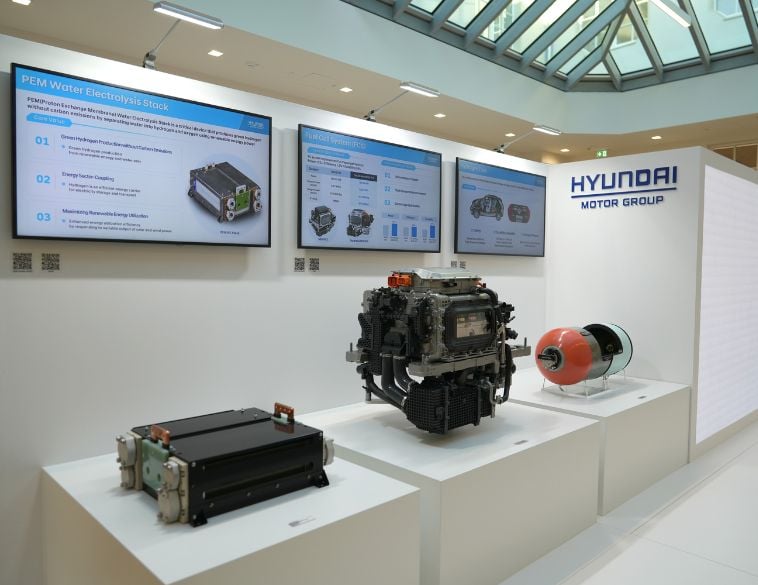
Speaking at the Aachen Automotive Colloquium in Germany, Hyundai Motor Group outlined its long-term engineering strategy centered on combining artificial intelligence with hardware development.
Hyundai Motor Group’s multi-energy roadmap presented at the Aachen Colloquium provides commercial operators with adaptable powertrain options to manage global transition uncertainty.
Speaking at the Aachen Automotive Colloquium in Germany, Hyundai Motor Group outlined its long-term engineering strategy centered on combining artificial intelligence with hardware development. Addressing global industry leaders, the company emphasized that future fleet and passenger mobility will rely on a spectrum of connected powertrain technologies rather than a single electrification source.
The core of the presentation detailed an expanded multi-pathway strategy encompassing battery electric vehicles (BEVs), hybrid electrics (HEVs), hydrogen fuel cells (FCEVs), and extended-range electric vehicles (EREVs). For North American fleet managers and automotive suppliers, the rollout of EREV systems—which utilize a gasoline generator to power an electric drivetrain—offers a practical bridge to overcome charging infrastructure gaps and severe weather range penalties.
In parallel, Hyundai is embedding digital twin technology and a continuous “Data Flywheel” into its R&D framework. By leveraging virtual validation and continuous fleet data analysis, the group aims to shorten vehicle development cycles, refine thermal management for next-generation battery chemistry, and optimize long-term total cost of ownership across diverse vehicle applications.
Tags : Hyundai


JOBS
 |  MONTRÉAL MONTRÉAL Permanent Permanent |
 | MONTRÉAL Full time |
 | SECTEUR GATINEAU - OTTAWA Full time |
| BROSSARD Permanent |
 | DOLLARD-DES-ORMEAUX Full time |