
The Trust Factor: Why Digital Inspections Matter
Autosphere » Mechanical »

Digital Vehicle Inspections are revolutionizing relationships between customers and service repair centres. Credit: Mitchell 1
How DVIs are changing the service centre customer experience
Few technologies have transformed the relationship between repair facilities and their customers as profoundly as digital vehicle inspections (DVIs). Over the last two decades, DVIs have changed the way shops communicate, turning what was once a conversation built largely on verbal explanations into one grounded in transparency, trust and visual proof.
Information at their fingertips
Vehicle owners now expect the same level of convenience and transparency from their repair facility that they receive from retailers, banks and healthcare providers. They expect information at their fingertips, mobile-friendly experiences and clear communication.
At a time when higher costs are prompting many drivers to hold onto their vehicles longer, customers are also becoming more thoughtful about maintenance and repair spending. They want to understand what needs attention now, what can wait and why certain recommendations are being made so they can plan and budget accordingly.
Meanwhile, repair facilities face growing pressure to improve productivity, keep service bays full, and strengthen customer relationships. Those goals become increasingly difficult to achieve when inspections, estimates and approvals are managed through manual, disconnected processes.
“As competition increases and customer expectations continue to rise, the facilities that thrive will be those that combine technical expertise with modern communication and connected workflows.”
Building customer confidence
Today, the challenge is no longer simply performing a quality inspection. It is turning inspection findings into customer understanding, faster decisions and productive repairs.
Digital vehicle inspection software helps make those conversations easier. By showing customers exactly what technicians are seeing, DVIs remove much of the uncertainty surrounding repair decisions and give vehicle owners the information they need to plan and budget for upcoming work.
Just as importantly, they help prepare customers mentally for the conversation ahead. Instead of being caught off guard by unexpected recommendations, customers have time to understand the issue, prioritize repairs and feel more confident moving forward.
For repair facilities, that means fewer surprises, better conversations and faster decisions. But the challenge today is no longer simply performing a quality inspection. It is turning inspection findings into customer understanding, quicker approvals and productive repairs.
Competitive advantage
Trust has always been the foundation of the automotive service business. Yet as vehicles become more complex and repair costs rise, earning that trust requires more than a verbal explanation.
When customers are asked to approve repairs based solely on descriptions, uncertainty can slow decisions. Questions arise. Recommendations may be postponed. In some cases, necessary work is declined simply because customers lack confidence in what they are being told.
Visual documentation
Photos, videos and technician notes from digital vehicle inspection tools, including apps, allow customers to see worn brake pads, leaking components or damaged belts for themselves. Instead of feeling like they are being sold a repair, they become part of the decision-making process.
Clear communication can lead to:
• Greater customer confidence
• Fewer misunderstandings and disputes
• Higher approval rates
• Better documentation of vehicle condition
• Stronger long-term customer relationships
For independent repair facilities, trust remains one of the strongest competitive advantages.
Speed is critical
Today’s customers manage much of their lives through their phones. They schedule appointments, pay bills, and approve purchases without needing to be physically present. Vehicle repair decisions are no different.
Customers increasingly expect the ability to review recommendations and approve work when and where it is convenient for them. For repair facilities, that convenience delivers operational benefits as well.
Every hour spent waiting for approvals delays production. Vehicles occupy bays longer. Technicians move on to other jobs. Schedules become more difficult to manage. Reducing approval times is not simply about customer convenience. It directly impacts throughput and profitability.
Hidden costs of fragmentation
Many facilities still rely on fragmented workflows. Inspection findings may be documented in one application while estimates are created in another. Photos may be stored separately and approvals tracked through text messages, emails or phone calls. Service advisors often find themselves re-entering information manually.
These handoffs consume valuable time and introduce opportunities for mistakes. Disconnected workflows can result in:
• Duplicate data entry
• Delays in estimate creation
• Communication breakdowns between technicians and advisors
• Missed repair opportunities
• Inconsistent recommendations
• Increased administrative workload
Small inefficiencies may seem insignificant, but multiplied across dozens of repair orders each week, they can have a meaningful impact on productivity.
A technician waiting on approvals is not generating labour hours. An advisor re-entering inspection findings is not helping customers. Workflow friction affects the entire operation.
Strategic inspections
Automotive digital vehicle inspections have evolved far beyond electronic checklists.
Leading repair facilities are using them as the foundation for better communication, more consistent processes and improved workflow efficiency. A properly documented inspection creates a common language between technicians, service advisors and customers while ensuring recommendations are presented clearly and professionally.
Consistency matters because missed opportunities often stem from process gaps rather than a lack of demand. Vehicles arrive every day needing maintenance and repairs. The challenge is making sure those needs are identified, documented and communicated effectively.
When inspections connect naturally with estimating and approval processes, repair facilities benefit from:
• Faster estimate creation
• Better communication between technicians and advisors
• Improved vehicle throughput
• More consistent recommendations
• Greater visibility into work in progress
• Increased opportunities to capture additional needed services
The result is not simply a better inspection process. It is a better customer experience and a more efficient business.
Connected workflows count
Technology alone does not eliminate bottlenecks. Integration does. When inspection findings live separately from estimating systems, information must be transferred manually. Every handoff creates delays and increases the likelihood that recommendations will be overlooked.
Connected workflows allow information to move seamlessly from inspection to estimate to customer approval. Advisors spend less time on administrative tasks and more time communicating with customers. Technicians spend more time repairing vehicles and less time waiting for decisions.
The most efficient facilities are often those that remove unnecessary steps and create a smoother experience for both customers and staff.
Bringing it all together
This growing need for connected workflows is driving the next generation of digital inspection platforms. OneFlow Inspections from Mitchell 1 was designed to help repair facilities streamline communication between technicians, service advisors and customers. Technicians can document findings with photos, videos and notes while customers receive branded inspection reports they can review remotely.
Working alongside OneFlow Estimator, powered by the Snap-on Digital Engine, the solution helps service advisors quickly identify appropriate labour operations, parts and related services using data derived from billions of verified repair records.
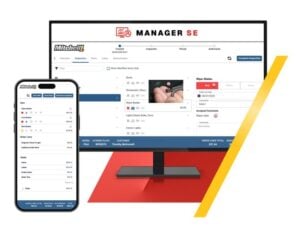
Integrated within the Manager SE shop management system, the combined workflow helps eliminate manual steps, improve communication and accelerate repair decisions.
Delivering more
Successful repair facilities understand that fixing vehicles is only part of the customer experience.
Today’s customers expect transparency. They expect convenience. They expect confidence that recommended repairs are legitimate and necessary. Digital vehicle inspections are no longer just a technology upgrade. They have become a strategic tool for building trust, improving efficiency and creating a more consistent customer experience.
As competition increases and customer expectations continue to rise, the facilities that thrive will be those that combine technical expertise with modern communication and connected workflows.
Because in today’s service environment, the ability to communicate clearly and move work efficiently can be just as important as the repair itself.
Interested in learning more about OneFlow Inspections? Click here to schedule a free demo.



JOBS
 |  LAVAL LAVAL Full time Full time |
 | LAVAL Full time |
 | QUÉBEC Full time |
 | SAINT-LAURENT Permanent |
 | MONTRÉAL Full time |